

My Role
Founding Product Designer
I was responsible for all things design and research at Berry Street. I conducted my own user research, talking directly with patients and dietitians, and worked closely with the cofounders to shape project direction. Day to day, I partnered with a PM and a small team of engineers to design and ship the product. Beyond pixels, I helped define what we were building and why.
01 What is Berry Street?
Berry Street is a telehealth platform that matches patients with registered dietitians. Patients describe what diet-related issues they want help with, get matched with a dietitian, and can schedule an appointment all in one flow.
For Patients
Most patients had no idea their insurance covered dietitian visits. Discovering they could see a dietitian for free was a big deal.
For Dietitians
Berry Street handles insurance claims, billing, and finding patients. Dietitians trust the platform to bring them patients so they can focus on care.
The challenge was never getting people in the door. It was getting them to come back.
02 The Problem
Patient retention was a core business problem and one of Berry Street's leading KPIs. The company spent significant advertising dollars to acquire each patient, and needed them to come back for at least 3 or 4 visits to recoup that cost. But patients were disappearing between appointments. Once a session ended, there was no touchpoint, no reason to come back. Patients averaged roughly 2 visits, then dropped off.
Berry Street was paying to acquire every patient and losing most of them before they became profitable.
Retaining patients at a higher rate was critical to the business, but no one had figured out how to do it yet. That's where I came in.
03 Research
I ran the research myself, talking to over 33 patients and 10 dietitians, and sending out surveys to both groups.
Patient Survey
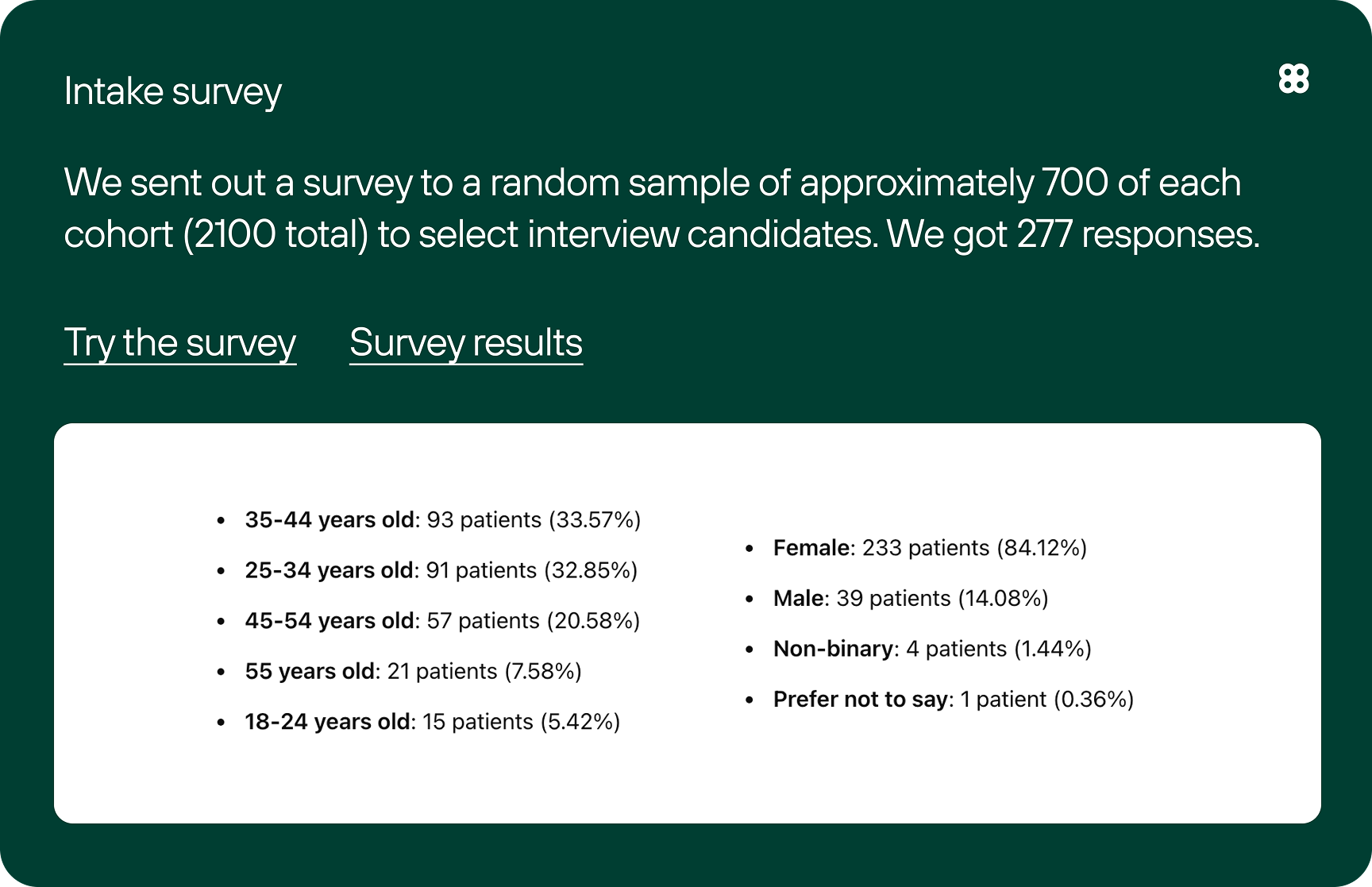
We surveyed 2,100 patients and got 277 responses. The data gave us a clear picture of who our patients were:
The majority of patients came to Berry Street because of some kind of weight-related concern, reinforcing the connection between weight management and food. Over a quarter of patients were already doing some form of food journaling as part of their treatment.
Dietitian Interviews
We were intentional about talking to both high-performing and low-performing dietitians. We also sent a survey to all dietitians on the platform. Approaches varied widely, but the patterns among the best-performing dietitians were clear:
- They created touchpoints outside of appointments, like food journaling or check-in messages
- They set small, attainable goals rather than big lifestyle overhauls
- They acted as accountability partners, not just static sources of information
Food journaling was consistently a top activity among high-retention dietitians. The dietitians who kept patients coming back weren't the ones giving the best advice. They were the ones who stayed present between visits.
What patients told us
We saw a stark divide. Patients who came to many appointments found nutrition therapy to be life-changing, a huge unlock. They treated Berry Street as an accountability partner to help them achieve their goals. Patients who dropped off early had sessions that were largely about getting information and learning basic concepts.
"I didn't come to my next appointment because I got all the information I needed, and I wasn't sure what we'd talk about."
"I tried food journaling, but I found it overwhelming."
Patients who left early felt like they could have gotten the same information from a Google search. The takeaway was clear: Berry Street needed to function as an accountability partner, not just a source of nutrition expertise.
What dietitians told us
Dietitians told us that patients do best when given small, attainable goals. Big lifestyle overhauls don't stick. Establishing quick wins early gets patients bought in on nutrition therapy and gives them a reason to come back.
"Patients tend to get obsessed with numbers like calories or macros, so I tend to avoid discussing them. But it is helpful to have an idea of what somebody is eating. It helps them be honest."
The Key Insight
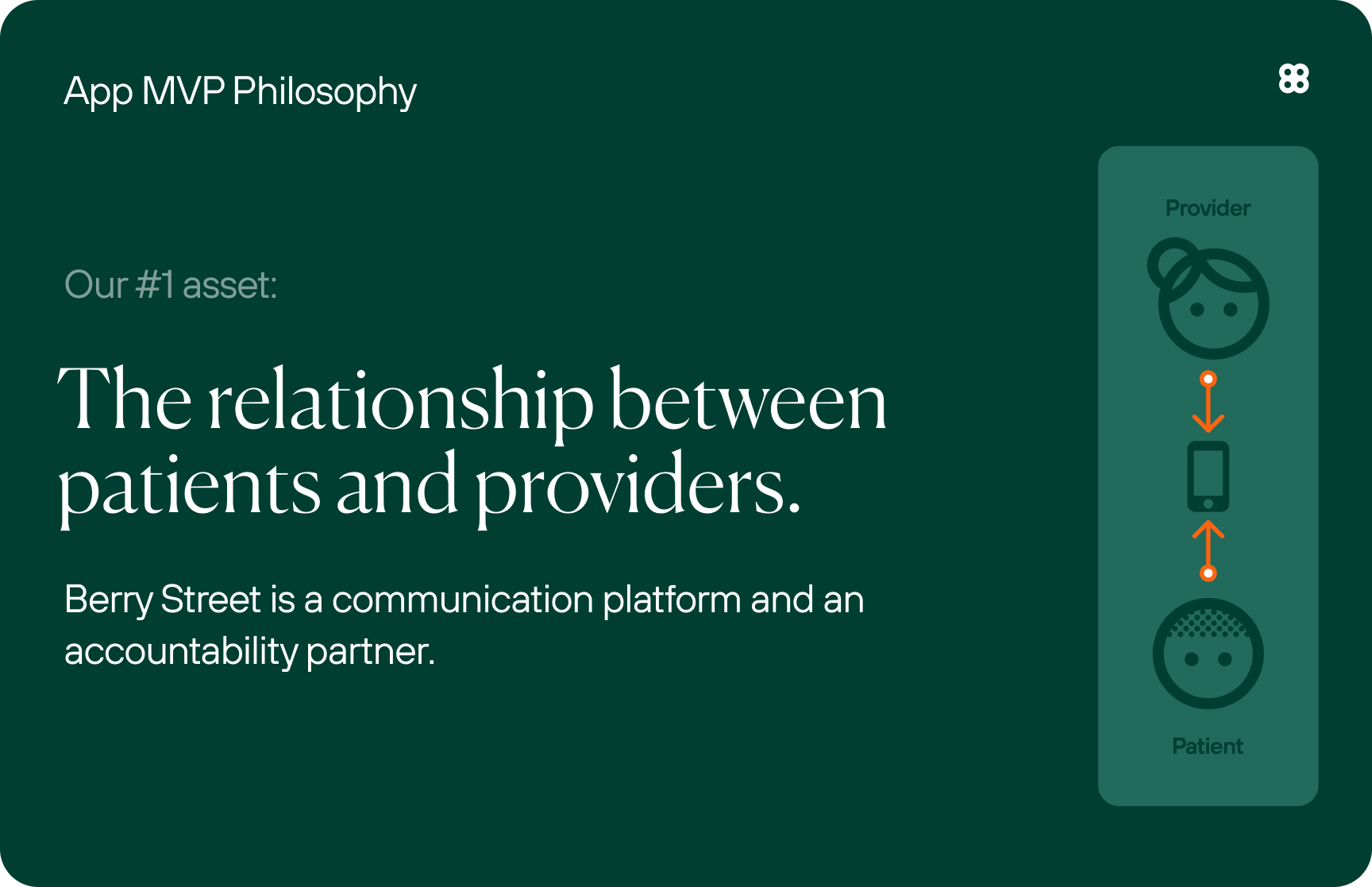
The research pointed to the same conclusion from both sides. Patients didn't come back when they felt like they'd gotten all the information they needed. Dietitians kept patients by staying present and setting small goals.
The answer was micro-goals: small, concrete actions that keep patients engaged and give dietitians something to work with.
"Write down what you eat for a week and we'll find the patterns together."
That's what the best dietitians were already doing. Food journaling emerged as the critical first step. It leads to longer-term goals like weight loss or healthier habits. It gives dietitians something concrete to discuss in follow-ups. And it gives patients a daily reason to open the app.
04 Making the Case for an App
Building an app wasn't an obvious use of our limited resources. With a small team, we could have focused on improving conversion in the booking funnel or operationalizing insurance claims. I worked with the cofounders and my PM to build the case that a patient-facing app was the highest-leverage bet because it directly addressed retention, the company's most critical problem.
Take the behaviors that the best dietitians do naturally and bake them into the app so every patient benefits.
The app needed to function as an extension of the patient-dietitian relationship, not a standalone tool. The strategy had two layers, each targeting a specific drop-off point:
Layer 1: Reduce Friction → Get to Visit 2
Make it easy to schedule appointments and chat with your dietitian. Remove the barriers to coming back.
Layer 2: Create Daily Touchpoints → Get to Visits 3 & 4
A food journal gives patients a reason to engage with Berry Street every day, gives them more to talk about in their next session, and encourages them to book another appointment. This is where the business becomes profitable.
05 The Dietitian Feedback Council
Dietitians are free agents. Berry Street can't mandate they use anything. If they didn't encourage patients to use the app, it wouldn't matter how good we built it. I created a dietitian feedback council: a standing forum of our best dietitians that served as a gut check for every major decision.
Shaped the product directly
They pushed us to use neutral language in AI food journal prompts and suggested ways to encourage more frequent journaling.
Predicted patient behavior
Dietitians had strong instincts for how patients would react to features and engage with the app day to day.
Created champions
Giving dietitians ownership over the product made them more likely to recommend it to their patients.
06 The Third-Party App Mistake
Before we could build our own app, we made a pragmatic but costly decision: we adopted a third-party patient app as a stopgap. In the short term it was a nice shortcut. Patients had something to use.
But the problems compounded:
- It was a bad experience. The app hurt patients' perception of Berry Street and made people skeptical about trying our eventual replacement.
- Feature bloat for the wrong audience. The third-party app had tons of features useful for a very small subset of users, but not for our general patient population.
- Painful migration. When we launched our own app, we had to remove features some patients relied on. That alienated a vocal minority, and we were forced to continue supporting the legacy app, a sustained drain on engineering resources.
Shortcuts that damage trust are expensive to recover from.
07 Building the App
The app started as a vibe-coded prototype built by a single engineer. We built it in React Native so we could ship to both iOS and Android from a single codebase. This was an important decision given how small our engineering team was, and we didn't have the resources to maintain two native apps. We expanded it in phases.
Phase 1: MVP
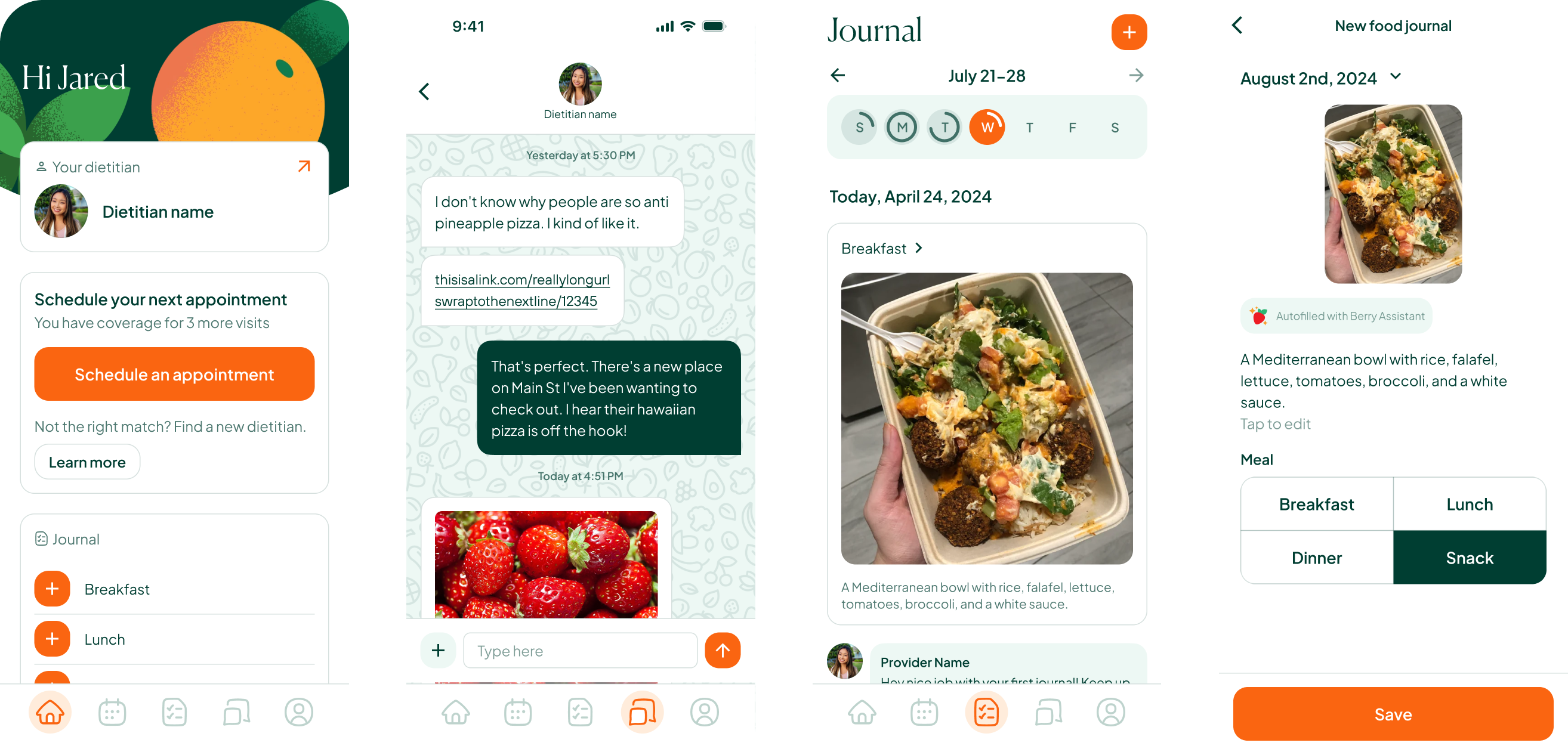
The MVP focused on appointment scheduling and dietitian messaging. We couldn't expect patients to come back for more visits if there wasn't an easy way to schedule the next one. Our research revealed that dietitians would often forget to ask patients to book a follow-up during their session, so having a place to do that online was critical. The MVP gave patients a Berry Street-owned touchpoint and replaced the third-party app with the bare essentials.
Phase 2: Food Journal
The core differentiator. This is where the research insights came to life. We didn't begin our marketing push until the food journal was in place. We knew this was the feature that would give patients a reason to open the app every day.
08 AI-Powered Food Descriptions
We wanted our food journal to be different from what was already out there. Apps like MyFitnessPal required a high level of detail: calories, macronutrients, protein counts. Even when those fields were optional, users perceived them as requirements. Patients found it overwhelming and time-consuming. Dietitians told us that level of detail wasn't even particularly useful and didn't improve patient outcomes.
What mattered was understanding what someone ate and roughly how much, not precise calorie counts.
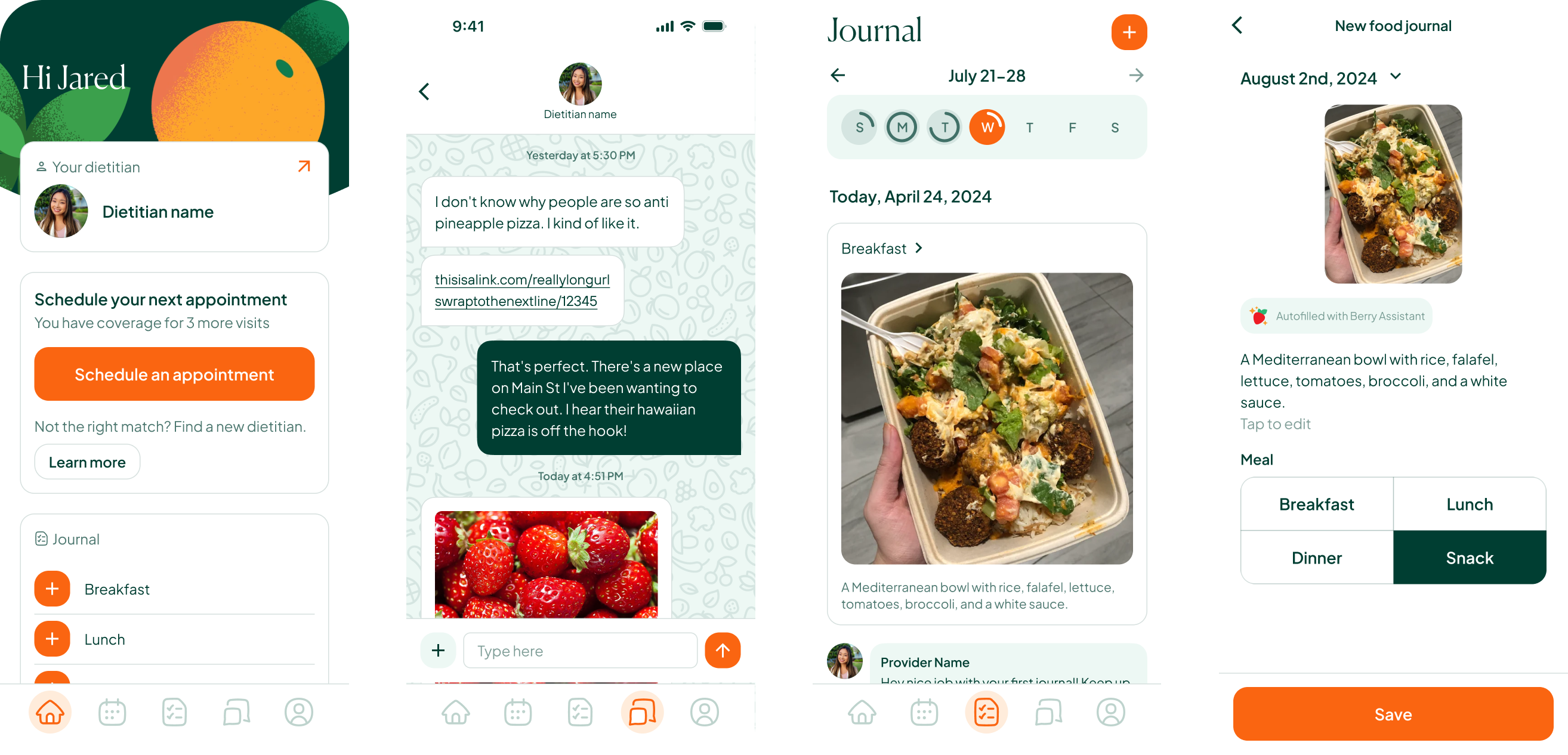
We used AI to describe food from photos, making data entry easier and the journal richer without requiring more work from patients. Take a photo, and the AI describes what's in the picture and the approximate amounts. No calorie counts. No macro breakdowns.
Building Guardrails
I was initially skeptical that AI descriptions would prove useful, but during beta testing patients and dietitians both felt like it was magic. The descriptions saved time and lowered the barrier to journaling.
We iterated on the descriptions to keep them simple and accurate. There was a phase where we had to build guardrails so the AI wouldn't hallucinate inaccurate descriptions or add details about things that weren't in the photo. It was my job to vet the different AI models and choose the one that performed best. The model we landed on was Gemini 2 Flash, with a deliberately constrained prompt:
Describe all the food in the image without any of the accompanying items like plates, bowls, or silverware. Avoid overly descriptive language. Don't include adjectives like "healthy" or "large." Don't make any assessments about healthiness. Include an estimate of portion size. Why this worked
Patients loved it
They saw it as saving time compared to manual entry. The barrier to journaling dropped significantly.
Descriptions were more useful than numbers
They allowed us to surface patterns and recommend dietary improvements. What someone eats over time is richer data than calorie counts.
A real differentiator
Incumbent apps were stuck in the "log every macro" paradigm. We designed around what AI was actually good at, which happened to align with what dietitians recommended.
09 Iterating After Launch
The initial food journal had usability issues we only discovered with real usage.
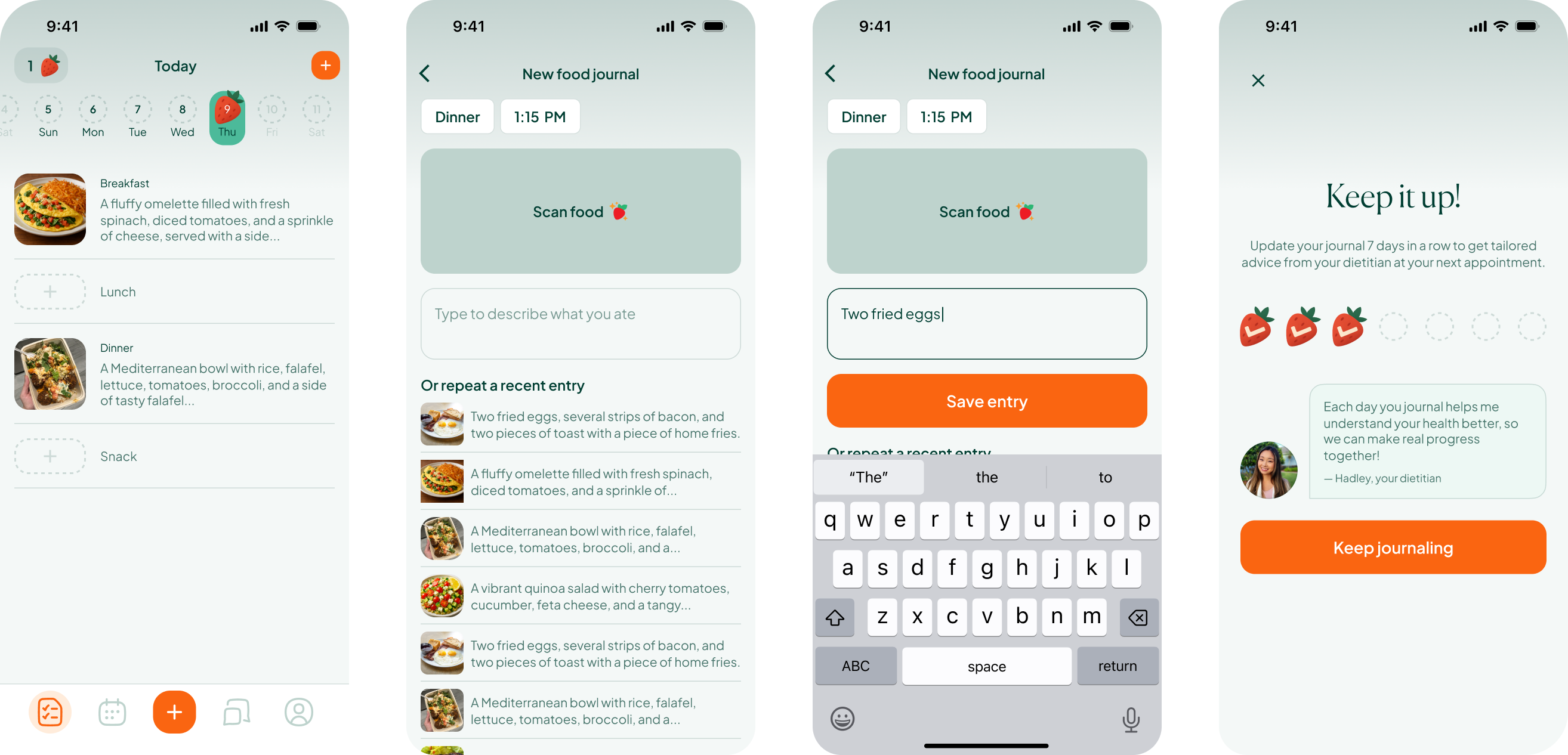
Repeat entries. Patients would upload the same photo day after day instead of taking a new one. We added a "repeat entry" feature so people could quickly log meals they eat regularly.
Backdating entries. Patients would procrastinate, sometimes up to a week, taking photos but not logging them. When they tried to upload later, it wasn't clear how to navigate to a past day and add food. They had to manually pick dates over and over. We simplified past-day navigation, which led to a measurable lift in food journal posts.
The Dietitian Loop
A critical piece we didn't fully anticipate: dietitian interaction made the journal stick. Dietitians would comment and leave feedback on patients' food posts. Knowing their dietitian could see what they were eating, and would respond, gave patients a reason to keep logging.
The food journal wasn't just a self-tracking tool. It was a communication channel.
Proving Impact and Investing Further
Once we proved the food journal was driving retention, we were able to dedicate more time to revisit and improve it. We gamified usage, added quality-of-life features like repeat meals and easier past-day posting, and refined the overall experience.
10 Results
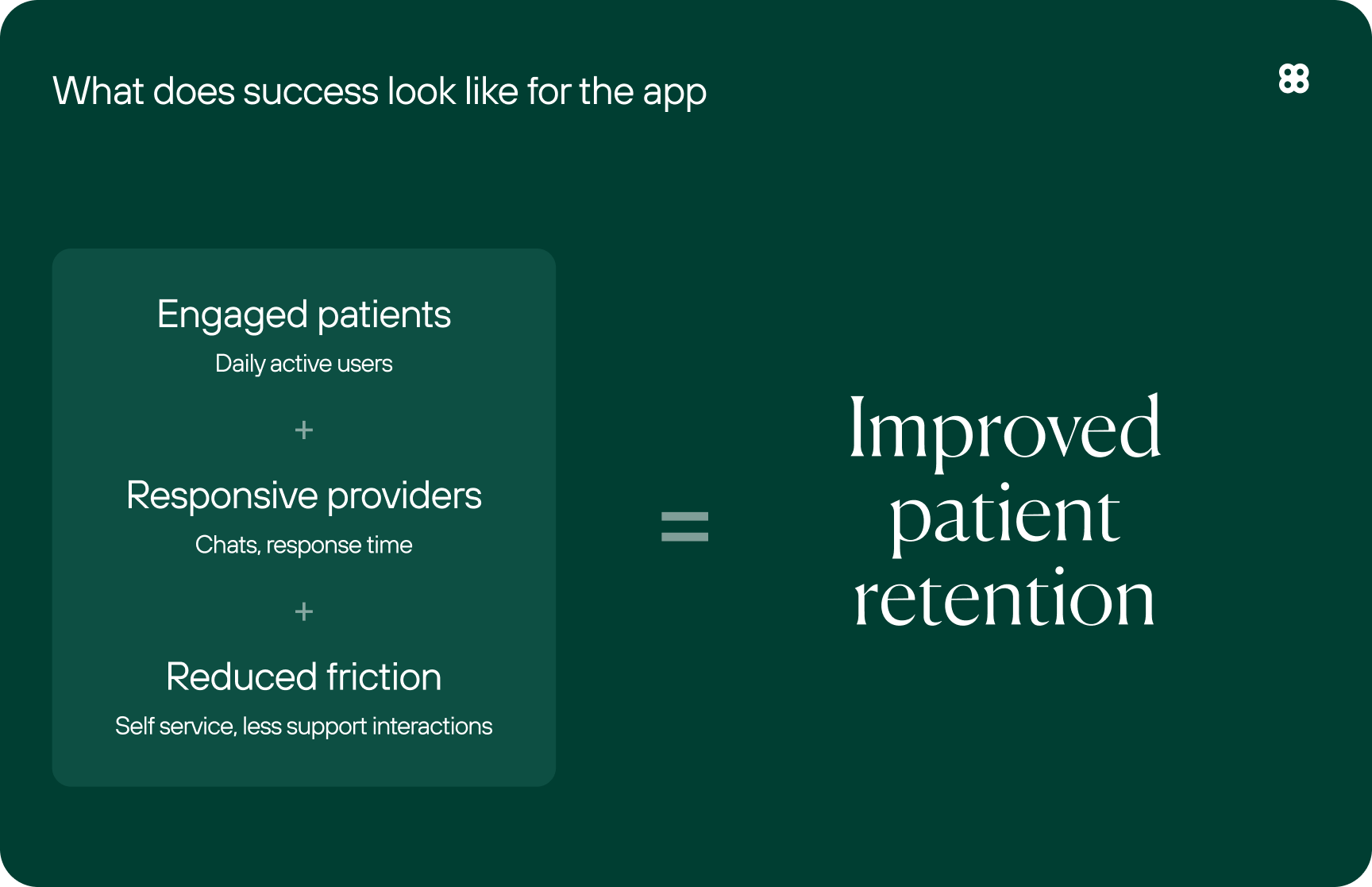
The thesis held. Patients who engaged with the food journal came to an average of two more visits. In a business where profitability starts at visit 3, that was transformative.
The app reached over 700 daily active users, with thousands of food journal entries posted every day. Engagement was high and sustained.
"Journaling my food helped me be aware of what I was eating. I noticed patterns I didn't know were there before."
What came next
With the food journal proven, the next lever for retention was dietitian adoption. Not all dietitians were integrating the app into their practice, and patients whose dietitians actively used the app had much higher engagement. Increasing dietitian adoption of the app became the next driver of retention.
11 Design System
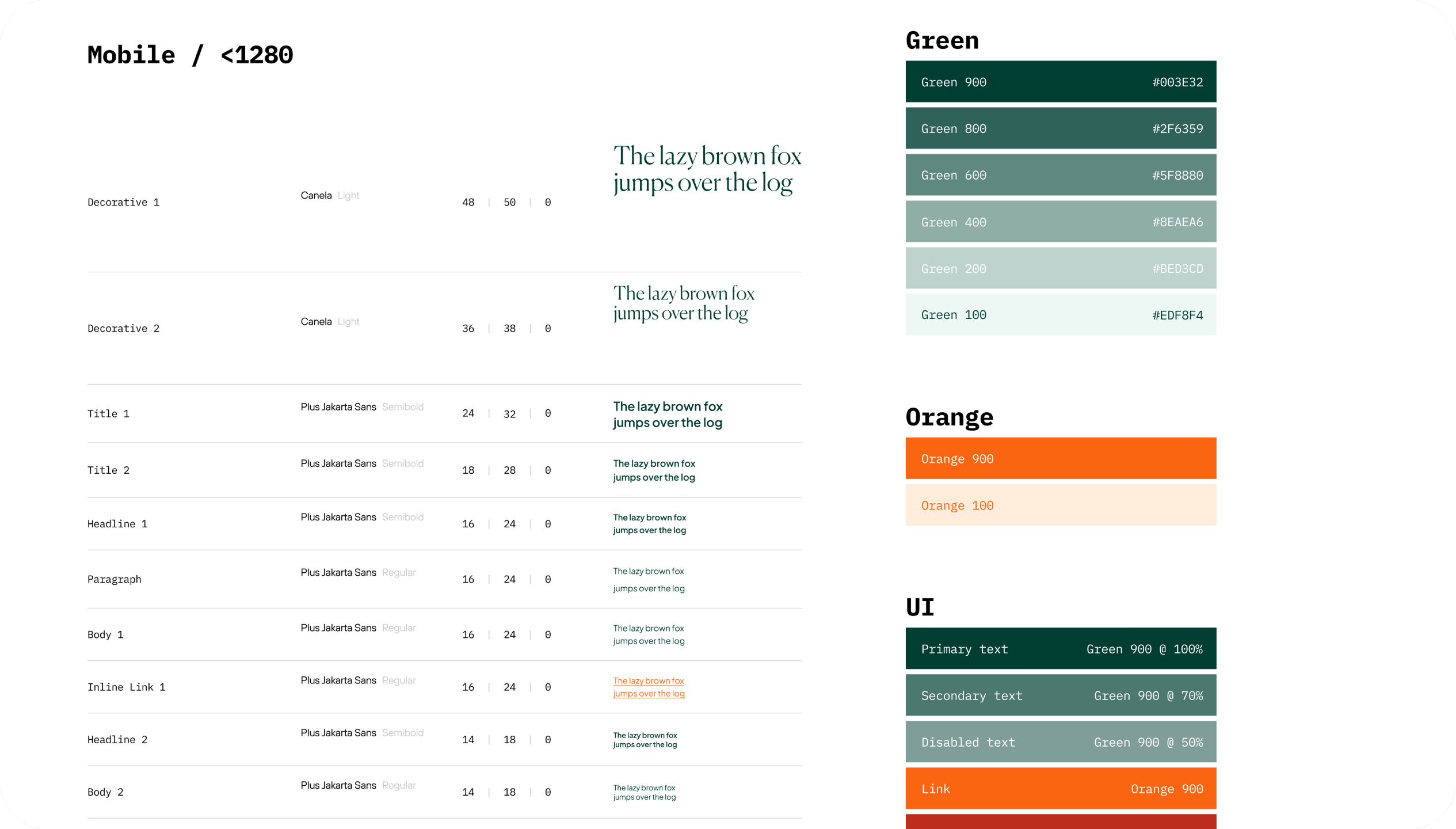
Berry Street had multiple surfaces to design for: a dietitian app, a patient app, a marketing website, and a booking flow. As the only designer working with a small engineering team, I needed styles and terminology to be transportable and universal.
I created a Figma-based design system and worked with my team to implement it, establishing clear and consistent naming conventions and tokens for colors, spacing, and typography across all surfaces. When switching between projects, the team could use the same language and context, and consistency was enforced across the product.
12 Other Things I Built
Beyond the patient app, I designed several other core products at Berry Street:
Booking Funnel
Improved the patient booking flow to increase conversion and lower customer acquisition cost.
Live Video Call Platform
Built a video call experience for dietitians that surfaced patient information, insurance details, and notes alongside the call. Providers had full context without switching tabs or tools.
Post-Appointment AI Tools
We studied what the best dietitians were doing after appointments and automated it: an AI notetaker that transcribed sessions and auto-filled charting and insurance paperwork, a follow-up email generator, and a meal plan generator.
Figure out what great dietitians do, then build tools so every dietitian can do it.
This saved providers 1+ hours of daily admin work.
13 Key Takeaways
Research-driven prioritization.
Food journaling wasn't an obvious choice. It emerged from talking to 20+ patients and dietitians.
Don't fight the technology.
AI was bad at calorie counts but great at food identification. Design around what works.
Micro-goals drive engagement.
Behavior change happens in baby steps, not information dumps.
Skepticism can be productive.
Pressure to add AI led to a great feature, but only because we were critical about how to use it.
Adoption is a design problem.
The dietitian feedback council wasn't a nice-to-have. It was essential to making the product succeed.